St. Moritz
Between Sun and Snow
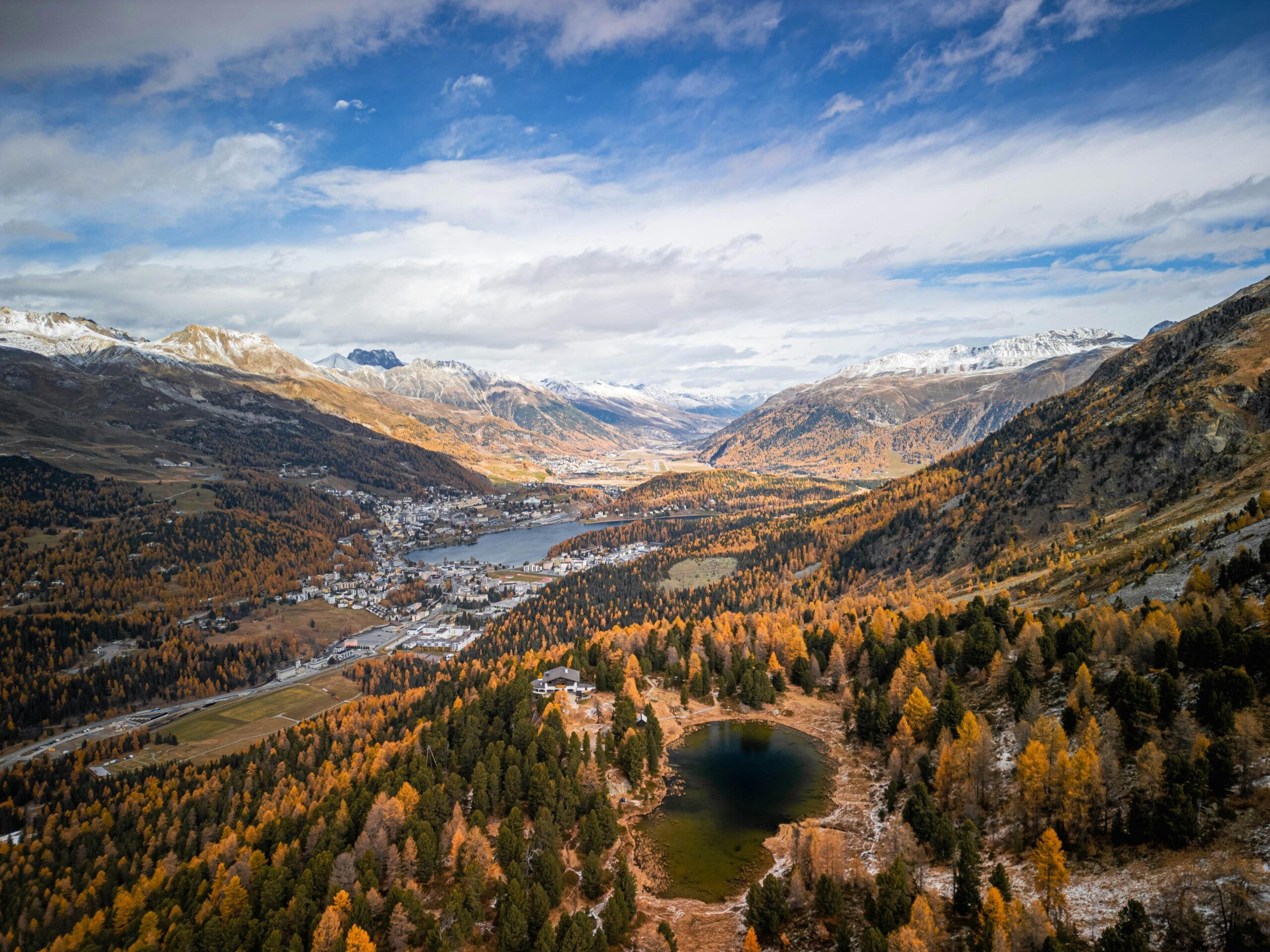
The true allure of St. Moritz isn’t a single bar, hotel or boutique. It’s that this village in Switzerland’s southeastern corner basks in a legendary 300 days of sunshine, a golden light that bounces off Lake St. Moritz with grand dame hotels sitting proudly above its shores. On the opposite bank, even the youth hostel wakes up to the same vintage light. The mountain peaks catch the sun while larch forests—green in summer, bare in winter and gorgeously golden in autumn—are the lungs of the Engadin.
“The air is a diamond,” Friedrich Nietzsche once wrote of the local area, “the most wonderful thing I have ever known.” And it’s easy to see what he means: hiking boots crunching along gravel paths, streams weaving through lush green meadows. Nature is as idyllic as it gets here, with fingernail-size wild strawberries ready to pick as you walk.
All hiking paths lead somewhere spectacular, like Alp Laret, reached on foot in about an hour or by the Celerina cable car in 30 minutes. Order Kaiserschmarrn, pillow-like pancakes, with fresh ricotta made from the cows grazing outside. Looking up from the plate, you’ll find alpine peaks in every direction.
“The air is a diamond..”
– Friedrich Nietzsche
When the trails lead downhill, the lakes take over. Walk past the lake into the larch forest, which opens up onto Lej da Staz. A wooden jetty leads out into an alpine painting, the backdrop to July’s Lej da Jazz. Come autumn, Lej da Staz becomes a pilgrimage for Swiss locals. When the larch needles turn, the lake’s reflection shifts from royal blue to gold, settling the valley into calm before the business of winter begins. Further afield, both the Morteratsch Glacier and Alp Grüm are easily reached by train along the Bernina route and compete for the best fall scenery.
When winter arrives, so do the skiers, both alpine and cross-country. The crowds build from the moment the slopes open in late fall, peaking at Christmas and again during Europe’s ski holidays in February. Those in the know wait until the crowds pass. By March, the slopes are quieter, it’s terrace weather, and ski jackets remain unzipped.
When the mountains release you, the village draws you in. Head to Café Belmont, where German, Italian, English and Romansh, Switzerland’s fourth official language, drift between tables. Where else would you find a curated champagne list and hiking boots at the same table? From croissants to charcuterie, the menu draws traffic all day long. For something stronger, N/5 THE Bar at Grace La Margna keeps pouring even when other five-star establishments have closed for the shoulder season. Or simply fill a water bottle from one of St. Moritz’s fountains: the grand cru of tap water.
“Some of the best chefs in the world call St. Moritz home.”
On sunny days, grab a Kalbsbratwurst from Hanselmann’s kiosk in the center of town. For truffled pizza, Chesa Veglia’s pizzeria sits in a house that dates back to 1658, making it the oldest in St. Moritz. Some of the best chefs in the world call St. Moritz home at one time or another, among them La Coupole – Matsuhisa, a restaurant inside Europe’s first indoor tennis hall.
Chefs and concepts come and go with the seasons, but what starts as a pop-up sometimes sticks around, like Super Mountain Market, a concept store and community hub bringing together local artisans and gastronomes.
From Nietzsche to painter Giovanni Segantini, creatives have been drawn to the Engadin valley for generations. The Segantini Museum, built from the artist’s own sketch, houses his Alpine Triptych: Life, Nature and Death under its dome. More contemporary work can be found at Galerie von Opel. Deep in the forest, the Mili Weber Museum is a house preserved exactly as the artist left it, a fairy-tale world of her paintings and the craftsmanship of her architect brother Emil. Tours by appointment only.
But the museums are no competition for what’s outside. It always comes back to the landscape. The air is sharp, the light shimmers as the sun sets behind the mountains, and the village hums. You don’t need to reach deep into your pockets to experience why people return year after year. That diamond air is free. So is the yearning to return.